Introduction
In an increasingly interconnected world, organisations have never possessed more channels through which they can communicate with their stakeholders. Websites, social media platforms, podcasts, webinars, newsletters and conferences have collectively transformed the ways in which knowledge can be created and disseminated. Yet despite this abundance of communication channels, many organisations continue to encounter a remarkably similar challenge. Their messages travel efficiently amongst people who are already familiar with their work, but seldom extend meaningfully beyond these existing communities. Knowledge circulates actively within established professional networks, while the wider society that organisations ultimately seek to serve remains largely untouched by the conversations taking place.
This phenomenon is commonly associated with the idea of an echo chamber. The term is frequently used to describe social media algorithms, political discourse and the reinforcement of existing beliefs through repeated exposure to similar viewpoints. However, the phenomenon itself is considerably broader. Echo chambers emerge whenever ideas, expertise and conversations repeatedly circulate within the same community while experiencing limited diffusion beyond it. They are therefore not merely technological artefacts, but natural characteristics of complex social systems. Every organisation, regardless of its mission or industry, develops its own sphere of influence, and every sphere of influence possesses a tendency to reinforce itself over time.
For organisations whose primary mission involves education, capability development or public engagement, this presents a significant strategic challenge. Success is often measured through indicators such as attendance, engagement rates, partnerships, media coverage or stakeholder participation. While these indicators remain valuable, they can also create the illusion that knowledge is diffusing widely throughout society when, in reality, it continues to circulate predominantly amongst individuals who were already interested in the subject. In other words, organisations may become increasingly effective at communicating within their own communities without necessarily becoming more effective at communicating beyond them.
The distinction between communication and knowledge diffusion is subtle, yet fundamentally important. Communication concerns the transmission of information from one party to another. Knowledge diffusion, by contrast, concerns the movement of ideas across communities, disciplines and social boundaries. An organisation may communicate frequently without substantially increasing the number or diversity of people who meaningfully engage with its work. Conversely, relatively modest interventions may sometimes generate disproportionately large shifts in public awareness if they successfully introduce knowledge into entirely new communities. The central challenge is therefore not simply whether organisations communicate, but whether knowledge successfully escapes the boundaries of its original community.
This essay proposes The Escape Velocity Model as a conceptual framework for understanding this challenge. Drawing inspiration from orbital mechanics, the model conceptualises organisational influence as a form of social gravity. Professional communities, much like celestial bodies, naturally attract individuals who already share similar interests, identities or expertise. As these relationships strengthen, ideas circulate increasingly efficiently within the community, creating a stable and self-reinforcing ecosystem of knowledge. Although such ecosystems are essential for advancing professional practice, they may also inadvertently limit the extent to which knowledge reaches neighbouring disciplines and the wider public. The challenge, therefore, is not merely to increase communication, but to understand how knowledge can move from one gravitational system into another.
The analogy with orbital mechanics is intended as a conceptual device rather than a literal comparison. Organisations do not obey the laws of physics, nor should social systems be reduced to physical models. Nevertheless, the language of gravity, trajectories and escape velocity provides a useful framework for examining how ideas travel through networks of people and institutions. More importantly, it offers an alternative perspective on organisational communication. Rather than asking how organisations might simply communicate more effectively, the model instead asks how organisations might intentionally reshape the pathways through which knowledge travels, thereby enabling ideas to diffuse across organisational, disciplinary and societal boundaries.
The motivation for developing this framework originated from an observation within the context of tax education, although the framework itself is intended to apply much more broadly. During my work with the Tax Academy of Singapore, I began reflecting on the communities that consistently engaged with the Academy’s educational initiatives and public communications. While these observations arose within the tax profession, the underlying patterns appeared remarkably similar to those encountered across healthcare, cybersecurity, artificial intelligence, financial literacy, environmental sustainability and many other specialised fields. Each of these disciplines faces the same underlying systems challenge: how does specialised knowledge move beyond the communities that originally produced it and become meaningful to people whose interests lie elsewhere?
The pages that follow argue that this challenge cannot be understood solely through the lenses of marketing, communications or outreach. Instead, it should be viewed as a problem of organisational systems and knowledge diffusion. By introducing concepts such as knowledge gravity, escape energy and gravitational anomalies, the Escape Velocity Model seeks to provide a conceptual vocabulary for understanding how organisations may deliberately design environments that encourage knowledge to travel beyond its traditional sphere of influence. Although the discussion begins with tax education as a case study, the framework ultimately aspires to contribute to a broader conversation about cross-domain literacy, public value and the movement of knowledge across society.
Organisational Gravity
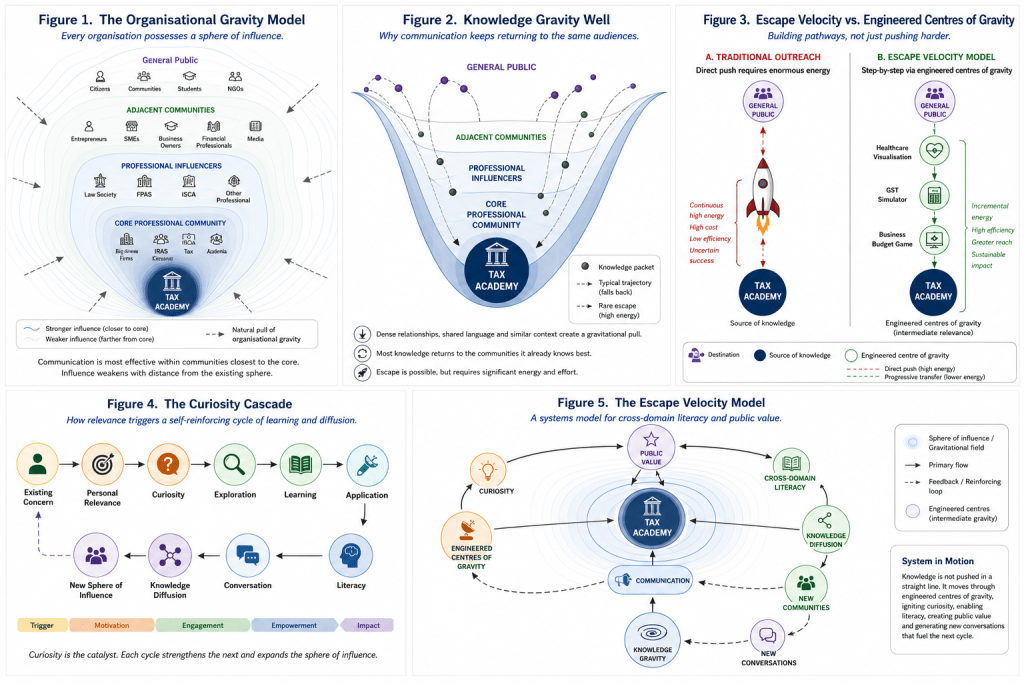
Every organisation, regardless of its purpose, gradually develops a sphere of influence. This sphere is not defined by geography or organisational hierarchy, but by the relationships that emerge between individuals who share common interests, professional identities, institutional affiliations and lived experiences. Through repeated interactions, these relationships evolve into networks through which information travels quickly and efficiently. Members of these networks speak a common language, possess similar contextual knowledge and frequently encounter comparable problems in their professional practice. Consequently, new ideas require relatively little explanation before they are understood, discussed and further disseminated throughout the community.
This process is neither accidental nor undesirable. Indeed, the development of such networks represents one of the defining characteristics of every mature profession. Medical practitioners continually exchange new clinical knowledge with other healthcare professionals. Lawyers debate legal developments with fellow practitioners. Engineers refine technical standards through professional institutions. Researchers publish within academic communities where specialised terminology, methodologies and theoretical assumptions are already widely understood. These networks provide the intellectual infrastructure through which disciplines advance. Without them, professional knowledge would struggle to accumulate, mature and evolve.
The existence of these communities, however, also produces an unintended consequence. As communication becomes increasingly efficient within the profession, organisations naturally begin directing more of their efforts towards audiences that are already familiar with the language, assumptions and priorities of the discipline. Educational programmes become progressively more specialised. Conferences attract participants who already possess substantial domain knowledge. Publications are written with practitioners in mind. Social media discussions increasingly involve individuals who are already connected through existing professional relationships. Over time, the organisation becomes exceptionally effective at communicating within its own sphere of influence.
This phenomenon may be described as knowledge gravity.
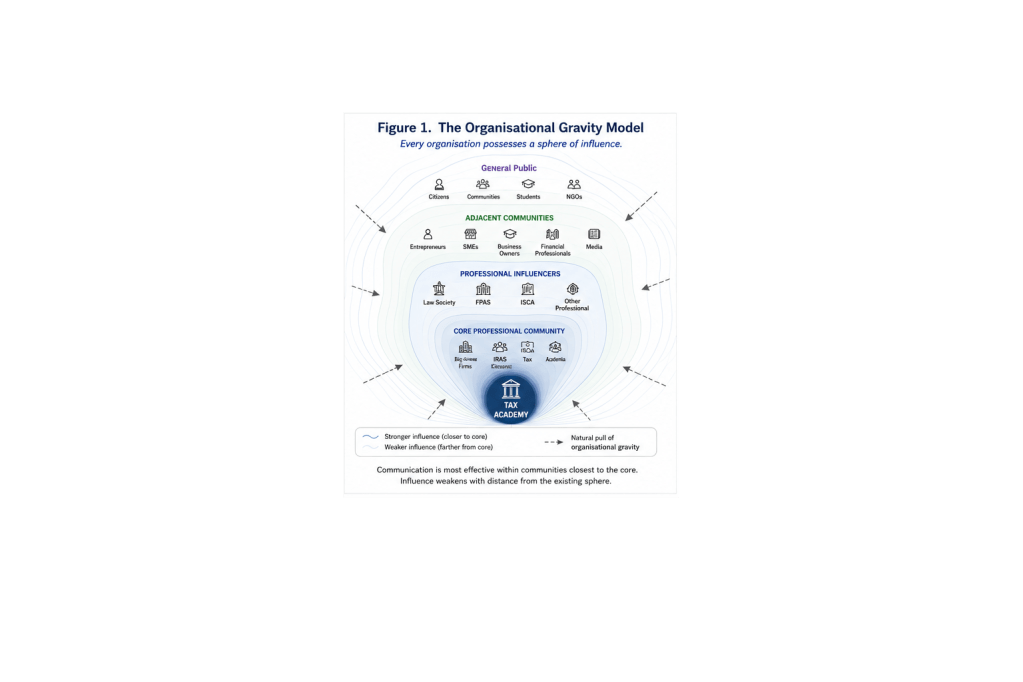
Knowledge gravity refers to the tendency for information to remain within the professional communities that originally produced it. Much like gravitational forces in orbital mechanics, the strength of this attraction increases as relationships become denser and interactions become more frequent. Existing practitioners continually reinforce one another’s understanding through conferences, publications, professional networks and digital communication platforms. Organisations, observing consistently high levels of engagement from these audiences, naturally continue investing resources into serving them. The resulting system becomes self-reinforcing. Knowledge circulates rapidly within the community, yet experiences comparatively little movement beyond it.
Importantly, knowledge gravity should not be interpreted as a communication failure. On the contrary, it is often an indicator of organisational success. Institutions that successfully cultivate professional communities frequently become recognised centres of excellence within their respective disciplines. Their programmes attract leading practitioners, their publications become influential references and their events provide valuable opportunities for collaboration and professional development. Strong knowledge gravity therefore reflects the presence of trust, credibility and sustained professional engagement.
The challenge emerges only when organisations mistake the strength of knowledge gravity for the breadth of knowledge diffusion.
High levels of engagement do not necessarily imply that knowledge is reaching new audiences. A conference attended by hundreds of experienced practitioners undoubtedly generates considerable professional value, yet it may contribute relatively little towards increasing public understanding if the participants largely represent the same community that has attended similar conferences for many years. Likewise, an article that receives thousands of views from existing professionals may appear highly successful while having almost no impact upon individuals outside the profession. The distinction is subtle because both scenarios produce encouraging metrics. Nevertheless, the first measures the circulation of knowledge within an existing network, whereas the second concerns the movement of knowledge into entirely new networks.
This distinction suggests that organisational influence may be understood along at least two different dimensions. The first is professional influence, which describes the extent to which an organisation strengthens capability, collaboration and knowledge exchange within its existing community of practice. Professional influence is essential because every discipline depends upon vibrant professional ecosystems in order to maintain standards, develop expertise and encourage innovation. The second is public influence, which describes the extent to which specialised knowledge travels beyond its original community and becomes meaningful to individuals who do not identify themselves as members of that profession. Public influence therefore concerns the diffusion of knowledge across organisational, disciplinary and societal boundaries rather than its circulation within them.
Although these two dimensions are closely related, success in one does not necessarily imply success in the other. Organisations frequently achieve remarkable professional influence while possessing relatively modest public influence. Conversely, certain organisations enjoy significant public visibility despite contributing comparatively little towards advancing professional knowledge. The strategic challenge for organisations whose mission involves creating public value lies not in choosing between these two forms of influence, but in understanding how they complement one another. Professional influence provides the expertise from which knowledge originates, while public influence determines how far that knowledge ultimately travels.
This distinction became increasingly apparent to me during my work at the Tax Academy of Singapore. Whenever the Academy announced a new programme, conference or educational initiative, the accompanying engagement consistently demonstrated the strength of Singapore’s tax ecosystem. Professionals from the Big Four accounting firms, officers from the Inland Revenue Authority of Singapore (IRAS), practitioners from mid-tier firms, members of the Law Society, representatives from the Institute of Singapore Chartered Accountants (ISCA), academics and long-standing industry partners actively participated in discussions surrounding the Academy’s work. Viewed through the lens of professional influence, this represented precisely what an educational institution should aspire towards. The Academy had successfully cultivated a community of practitioners committed to advancing tax knowledge and professional capability within Singapore.
At the same time, however, these observations also highlighted the limits of organisational gravity. While the Academy had become an important focal point within the tax profession, relatively few conversations appeared to extend beyond that professional ecosystem. Outside communities whose work naturally intersected with taxation, public awareness of the Academy remained comparatively limited. More importantly, taxation itself continued to be perceived by many individuals as a specialised technical subject that concerned accountants, lawyers or tax officers, rather than something that influenced broader questions surrounding business, public policy or everyday life.
It is important to emphasise that this observation should not be interpreted as a criticism of the Tax Academy or the tax profession. Indeed, the Academy has actively collaborated with organisations such as the Financial Planning Association of Singapore, the Law Society and numerous industry partners precisely because it recognises that taxation intersects with many other professions. Rather, the observation illustrates a systems challenge that extends well beyond tax education. Every specialised discipline, regardless of its subject matter, eventually encounters a similar point at which professional influence begins to outpace public influence. The resulting gap does not arise because organisations have failed to communicate effectively, but because knowledge naturally follows the pathways established by existing relationships.
Understanding this distinction fundamentally changes the nature of the problem. If organisational communication is viewed solely as the dissemination of information, then the intuitive response is simply to communicate more frequently, more broadly or more persuasively. However, if the underlying challenge concerns the movement of knowledge across different spheres of influence, then communication alone may prove insufficient. The more fundamental question becomes how organisations might intentionally reshape the pathways through which knowledge travels, enabling ideas to move from one professional community into another and eventually into the wider society.
It is this question that motivates the Escape Velocity Model. Before considering how knowledge might escape its existing sphere of influence, however, it is first necessary to examine why conventional approaches to communication often struggle to achieve this objective. The following section therefore considers the limitations of existing outreach models and explains why increasing communication effort alone rarely overcomes the gravitational forces that naturally keep knowledge within its original community.
Beyond Communication: The Limits of Existing Approaches
Recognising that knowledge has remained largely confined within existing professional communities, organisations have understandably devoted considerable effort towards extending their reach. Across both the public and private sectors, communication strategies have become increasingly sophisticated, combining digital marketing, stakeholder engagement, partnerships, public outreach, educational campaigns and media engagement in an effort to broaden awareness. Such approaches have undoubtedly contributed towards improving organisational visibility and increasing public participation across numerous domains. Nevertheless, despite these investments, many organisations continue to encounter remarkably similar challenges. Public understanding often remains limited, misconceptions persist, and meaningful engagement beyond existing communities develops only gradually.
This observation should not be interpreted as a criticism of contemporary communication practice. On the contrary, many of these approaches have demonstrated considerable success within the objectives they were originally designed to achieve. Marketing increases visibility. Partnerships strengthen networks. Public engagement builds trust. Educational programmes develop capability. Each contributes meaningfully towards organisational performance. However, these approaches are principally concerned with improving communication rather than understanding the mechanisms through which knowledge itself diffuses across different social systems.
Communication and knowledge diffusion, while closely related, should not be regarded as synonymous.
Communication concerns the successful transmission of information between an organisation and its intended audience. Knowledge diffusion concerns the extent to which ideas propagate across communities that do not yet share common professional identities, vocabularies or interests. An organisation may therefore become increasingly proficient at communicating without necessarily increasing the diversity of individuals who meaningfully engage with its work. The effectiveness of communication should not be measured solely by the number of people reached, but also by whether those individuals represent genuinely new communities or simply the continued participation of existing ones.
This distinction becomes particularly evident when considering organisational partnerships. Partnerships are frequently regarded as an effective mechanism for expanding organisational influence because they enable institutions to access audiences that would otherwise remain beyond their immediate reach. Tax Academy’s collaborations with organisations such as the Financial Planning Association of Singapore, the Law Society and various business associations illustrate this principle well. These collaborations acknowledge that taxation intersects naturally with financial planning, legal practice and business decision-making, thereby creating opportunities for knowledge to move beyond traditional tax audiences.
Partnerships, however, possess an inherent limitation. In many instances, they remain fundamentally organisation-driven. The originating organisation identifies another professional community, develops collaborative initiatives and introduces its expertise into that community. Although knowledge undoubtedly crosses organisational boundaries through such collaborations, the movement remains largely initiated and sustained by the originating institution. The receiving community participates because the opportunity has been deliberately created for them.
Such collaborations are both necessary and valuable. They represent an important mechanism through which neighbouring professions exchange knowledge and develop interdisciplinary understanding. Nevertheless, they seldom alter the underlying structure through which public interest emerges. The relationship remains predominantly supply-driven. Organisations continue deciding which audiences to approach, what knowledge should be communicated and how that communication should occur.
A similar observation may be made regarding educational outreach. Many institutions seeking to improve public literacy organise seminars, public lectures, awareness campaigns and educational resources designed specifically for non-specialist audiences. These initiatives frequently succeed in making specialised knowledge more accessible by reducing technical complexity and presenting information in more engaging formats. Yet they continue to rely upon an important assumption: namely, that members of the public are already sufficiently interested in the subject to voluntarily participate.
This assumption deserves closer examination.
Interest should not be regarded as an unlimited resource that organisations may simply draw upon whenever educational opportunities are created. Every individual possesses finite cognitive attention and is continually required to prioritise amongst countless competing demands. Family responsibilities, employment, financial concerns, health, education, recreation and personal relationships all compete for attention on a daily basis. Under such circumstances, specialised subjects that appear unrelated to an individual’s immediate concerns frequently receive little consideration, regardless of their objective importance.
The implication is significant.
Many organisations devote considerable effort towards making knowledge easier to understand while paying comparatively less attention to understanding why individuals would seek that knowledge in the first place.
This distinction recalls an important observation from consumer psychology. Successful organisations rarely begin by asking how they should communicate their products or services. Instead, they begin by understanding the problems, aspirations and decisions that already occupy the minds of their intended audiences. Communication therefore succeeds not merely because information is presented clearly, but because it connects naturally with questions that individuals are already attempting to answer.
The same principle may apply equally to public education and knowledge dissemination.
Individuals rarely become interested in taxation simply because taxation is important. They become interested when taxation intersects with issues that already matter to them. A young entrepreneur establishing a new business may begin asking questions about corporate taxation because those questions directly influence commercial decisions. A family purchasing their first home may become interested in property taxation because the subject has acquired immediate personal relevance. Citizens concerned about healthcare funding, education expenditure or the cost of living may gradually become interested in fiscal policy because taxation provides one of the mechanisms through which these broader societal questions are addressed.
Knowledge therefore appears to diffuse most effectively when it accompanies existing interests rather than attempting to create entirely new ones.
This observation also resonates strongly with findings from my Master’s dissertation examining fake news mitigation. One of the recurring themes emerging from the research was that exposure alone rarely produces meaningful engagement. Individuals do not critically evaluate every piece of information they encounter. Rather, they selectively allocate cognitive effort towards issues they perceive as relevant to their own circumstances. Educational attainment alone therefore does not necessarily determine whether individuals engage critically with a particular subject. Even highly educated individuals may devote little attention towards topics that appear unrelated to their own lives, while individuals possessing comparatively less formal education may demonstrate considerable analytical engagement once an issue intersects with their family, occupation, finances or personal aspirations.
Viewed collectively, these observations suggest that communication effort alone cannot fully explain how knowledge moves across different communities. Increasing the quantity of information produced, expanding communication channels or strengthening outreach strategies undoubtedly contributes towards organisational visibility. However, these approaches remain constrained by an important structural limitation. They continue assuming that knowledge should travel directly from the originating organisation to its intended audience.
Orbital mechanics offers an alternative perspective.
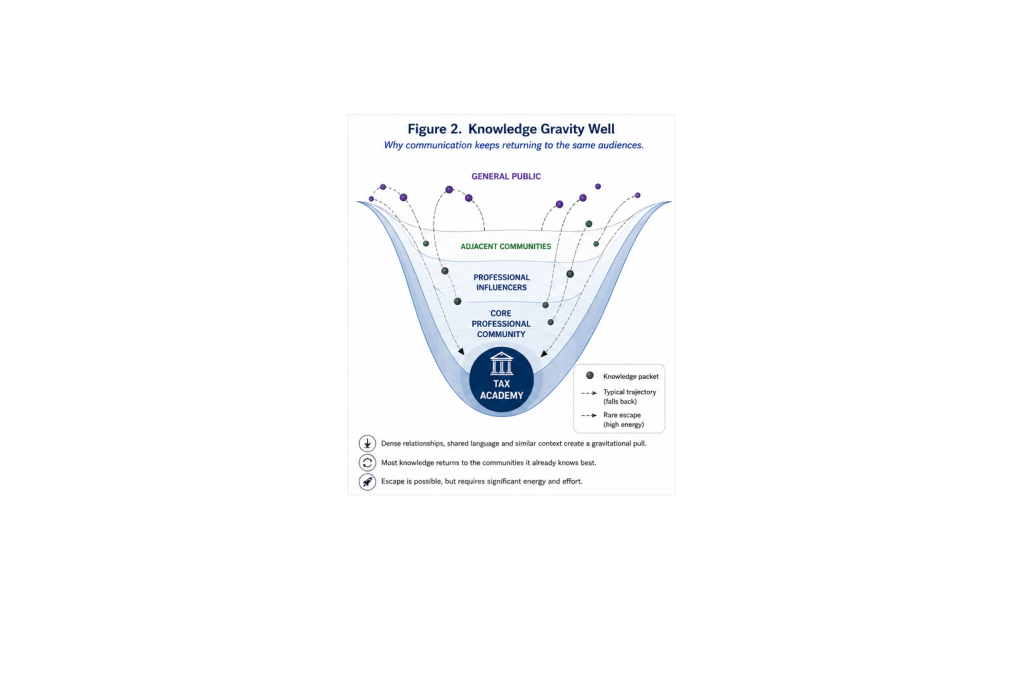
Although the term escape velocity commonly evokes images of rockets generating enormous amounts of thrust to leave the Earth’s gravitational field, modern space exploration rarely depends upon propulsion alone. Interplanetary missions frequently exploit the gravitational influence of other celestial bodies, allowing carefully planned trajectories to redirect and accelerate spacecraft while significantly reducing the energy required to reach distant destinations. Rather than overcoming every gravitational force encountered during the journey, mission designers intentionally incorporate additional gravitational influences into the trajectory itself.
This distinction is more than merely a physical curiosity. It suggests a fundamentally different way of thinking about organisational communication.
Perhaps organisations should not always seek to overcome the gravitational pull of their existing communities through ever-increasing communication effort. Perhaps a more effective strategy lies in deliberately creating new gravitational influences beyond their existing sphere of influence, allowing knowledge to travel progressively through interconnected communities rather than attempting to reach every destination directly.
Gravitational Anomalies: Engineering New Centres of Gravity
The preceding sections argued that organisations frequently struggle to extend specialised knowledge beyond their established communities because knowledge naturally follows existing social relationships. Communication therefore exhibits a form of organisational gravity, continually drawing conversations back towards audiences that already possess the interest, vocabulary and contextual understanding necessary to engage with the subject. Conventional approaches to outreach attempt to overcome this challenge primarily by increasing communication effort, expanding stakeholder engagement or strengthening organisational partnerships. While these approaches undoubtedly contribute towards greater visibility and collaboration, they continue to assume that knowledge must travel directly from the originating organisation to the intended audience.
The Escape Velocity Model proposes an alternative perspective.
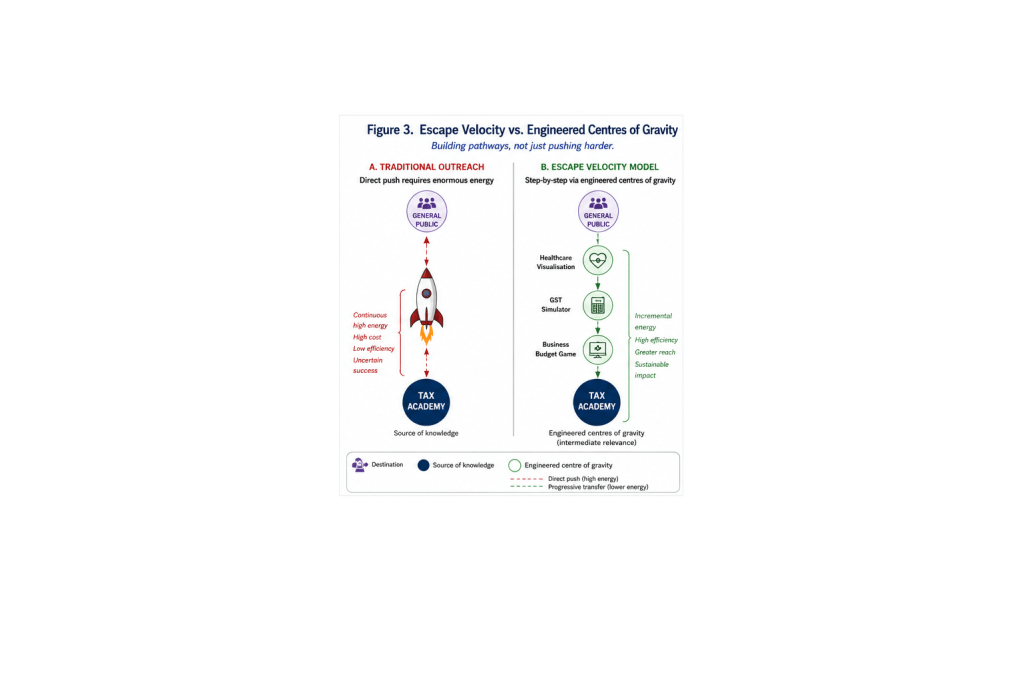
Rather than attempting to increase the amount of energy devoted to communication, organisations may instead reshape the landscape through which knowledge travels. Instead of treating public engagement as a direct transmission of information, they may deliberately construct intermediate centres of attraction that encourage individuals to enter the conversation voluntarily. These intentionally engineered centres of attraction are referred to within this framework as gravitational anomalies.
The term is employed conceptually rather than physically. In planetary science, a gravitational anomaly refers to a region where variations in mass produce measurable differences in the surrounding gravitational field. Within the Escape Velocity Model, however, a gravitational anomaly refers to an intentionally designed point of public relevance that attracts the attention of communities beyond an organisation’s existing sphere of influence. It represents an intervention that creates a new reason for individuals to engage with specialised knowledge, not because they were previously interested in the discipline itself, but because the discipline has become relevant to questions they already care about.
The distinction is important because it fundamentally changes the objective of organisational communication.
Traditionally, organisations begin with the knowledge they possess and subsequently determine how that knowledge should be communicated to others. Educational resources are developed, campaigns are organised and communication channels are selected with the expectation that broader exposure will eventually generate greater understanding. The underlying logic is essentially transmissive. Knowledge originates from the organisation and is delivered towards an intended audience.
Gravitational anomalies reverse this sequence.
Rather than beginning with the knowledge that organisations wish to communicate, they begin with the questions that society is already asking. The organisation first identifies issues that naturally attract public attention before designing experiences through which specialised knowledge becomes indispensable for understanding those issues. Knowledge therefore enters the conversation indirectly, not because individuals consciously sought to learn the discipline itself, but because the discipline provides the conceptual tools necessary for exploring questions that have already captured their interest.
This distinction may appear modest, yet it represents a profound shift in the philosophy of public engagement.
The objective is no longer to persuade society that a particular subject deserves attention.
The objective is to design environments in which society naturally discovers why that subject already matters.
The implications of this shift become particularly evident within tax education.
For many individuals, taxation is not a topic that occupies their daily thoughts. Outside periods of tax filing or major fiscal announcements, relatively few members of the public actively seek opportunities to deepen their understanding of tax policy. This does not necessarily reflect indifference towards taxation itself. Rather, it reflects the fact that taxation is often perceived as a specialised technical discipline primarily relevant to accountants, lawyers, financial professionals and government agencies.
Yet many of the questions that dominate public discourse are, in reality, deeply connected to taxation.
Citizens frequently debate the rising cost of living, healthcare expenditure, housing affordability, education funding, ageing populations, government spending, economic inequality, business competitiveness and social support programmes. Although these conversations rarely begin as discussions about taxation, taxation frequently constitutes one of the principal policy instruments through which governments respond to precisely these challenges.
This observation suggests that taxation need not always be introduced as the subject of the conversation.
Instead, taxation may emerge as a consequence of conversations that society is already having.
Consider, for example, public discussions surrounding the Goods and Services Tax (GST). Debates concerning GST often become polarised because participants naturally focus upon their own immediate experiences of rising prices while possessing only partial visibility of the broader fiscal system within which GST operates. Conventional educational approaches might respond by publishing explanatory articles describing how GST contributes towards government revenue or by organising seminars explaining fiscal policy.
A gravitational anomaly would approach the same challenge differently.
Imagine an interactive data visualisation platform through which members of the public could adjust GST rates and immediately observe projected implications for healthcare expenditure, education funding, infrastructure investment, social assistance programmes and long-term fiscal sustainability. Rather than simply reading about tax policy, individuals would actively explore the trade-offs involved in balancing competing national priorities. Questions that previously appeared ideological would gradually become analytical. Participants would begin experimenting with different scenarios, comparing outcomes and discovering for themselves why seemingly straightforward policy decisions frequently involve considerable complexity.
The platform itself is not merely an educational resource.
It functions as a gravitational anomaly.
Individuals are attracted because they are interested in the cost of living, public expenditure or government policy. Taxation enters the conversation because it provides the explanatory framework necessary for interpreting the consequences of different choices. Curiosity is therefore generated not through promotion, but through exploration.
The same principle may be extended considerably further.
Singapore’s declining total fertility rate has become the subject of sustained national discussion because of its implications for workforce participation, healthcare demand, retirement financing and long-term economic sustainability. An interactive demographic projection tool allowing individuals to explore different fertility scenarios and observe corresponding changes in healthcare expenditure, dependency ratios and projected tax requirements would similarly function as a gravitational anomaly. Members of the public would initially engage because they are interested in demographic change, housing affordability or economic sustainability. Through that engagement, taxation gradually emerges as one component within a much broader systems conversation.
Business owners provide another illustration. Entrepreneurs seldom begin their journey by searching for tax education. Instead, they concern themselves with business growth, financing, digital transformation, hiring decisions, overseas expansion and operational sustainability. Educational platforms designed around entrepreneurial decision-making could therefore introduce tax concepts precisely at the moments where they become strategically relevant. Rather than presenting taxation as a standalone discipline, taxation becomes embedded within the broader process of building and growing a successful enterprise.
Artificial intelligence, cybersecurity, climate transition, retirement planning and financial resilience all present similar opportunities.
Each represents an existing centre of public interest.
Each already possesses substantial gravitational influence.
Each therefore provides fertile ground upon which carefully designed gravitational anomalies may be constructed.
Viewed collectively, these examples suggest that organisations possess capabilities unavailable within physical systems. Spacecraft cannot create new planets to assist their journeys. Organisations, however, can deliberately create entirely new centres of public relevance through carefully designed experiences, digital platforms, simulations, policy tools, educational games and collaborative initiatives. These interventions reshape the pathways through which knowledge travels by establishing new gravitational influences that did not previously exist.
The significance of this observation extends beyond communication strategy.
Gravitational anomalies do not merely increase awareness.
They alter the trajectory of knowledge itself.
Rather than attempting to propel specialised knowledge directly towards distant audiences, organisations progressively guide knowledge through a sequence of interconnected spheres of relevance. Curiosity generated within one community creates opportunities for conversation within another, allowing knowledge to diffuse gradually across organisational, disciplinary and societal boundaries.
Escape velocity, within this framework, therefore acquires a broader meaning than its physical counterpart.
The objective is no longer to generate sufficient communication energy to overcome organisational gravity directly. Instead, organisations deliberately engineer new gravitational influences that progressively redirect the movement of ideas until specialised knowledge eventually reaches communities that would otherwise have remained beyond its natural sphere of influence.
Curiosity, Relevance and the Psychology of Knowledge Diffusion

The introduction of gravitational anomalies raises an important question. If organisations intentionally construct new centres of public relevance, why should these interventions succeed where conventional communication often struggles? Why would an interactive policy simulator, a demographic projection model or a business decision-making platform generate greater public engagement than a well-written article or a carefully designed awareness campaign?
The answer, I believe, lies not within communication itself, but within the psychology of human attention.
Contemporary society is characterised not by a shortage of information, but by an overwhelming abundance of it. Individuals are exposed daily to news articles, social media posts, advertisements, podcasts, videos, online courses and countless other forms of communication competing simultaneously for their attention. Under such conditions, attention becomes an increasingly scarce cognitive resource. It is therefore unrealistic to assume that individuals will devote meaningful effort towards understanding every issue that organisations consider important. Instead, people inevitably become selective, allocating their limited cognitive resources towards questions that they perceive as immediately relevant to their own lives.
This observation has important implications for public education.
Many educational initiatives implicitly assume that the principal barrier to learning is insufficient access to information. Consequently, organisations frequently invest considerable effort into making specialised knowledge more accessible, simplifying technical language, improving communication materials and expanding the availability of educational resources. These interventions undoubtedly improve the quality of communication. However, they do not necessarily address the more fundamental question of whether individuals possess sufficient motivation to engage with that information in the first place.
Access to knowledge and motivation to acquire knowledge are related, yet fundamentally different problems.
During my Master’s dissertation examining fake news mitigation, one of the recurring observations was that educational attainment alone did not adequately explain why individuals engaged critically with particular information. Popular discourse often assumes that higher levels of formal education naturally produce stronger critical thinking skills. The relationship, however, appeared considerably more nuanced. Individuals frequently demonstrated sophisticated reasoning within subjects that directly affected their personal lives while exhibiting comparatively little interest in equally important issues that appeared unrelated to their immediate circumstances.
This observation suggests that critical engagement is not determined solely by cognitive ability. It is also influenced by perceived relevance.
When an issue intersects with an individual’s occupation, financial wellbeing, family responsibilities or personal aspirations, curiosity frequently emerges without external encouragement. Questions begin to arise naturally. Individuals seek additional information, compare alternative perspectives, evaluate evidence and gradually construct more sophisticated mental models of the issue under consideration. In other words, curiosity often develops not because individuals consciously decide to become more knowledgeable, but because circumstances make knowledge personally valuable.
This sequence may be understood as a progressive process of cognitive engagement.
Perceived relevance encourages curiosity.
Curiosity motivates inquiry.
Inquiry facilitates learning.
Learning gradually develops into literacy.
Literacy, when reinforced through repeated application and discussion, eventually contributes towards informed participation within broader societal conversations.
The significance of this progression lies in the fact that organisations frequently attempt to intervene at its later stages while overlooking its earliest stages. Educational campaigns often begin by delivering information in the hope that curiosity will subsequently emerge. The Escape Velocity Model proposes reversing this sequence. Rather than beginning with information, organisations should first cultivate relevance. Curiosity then becomes a natural consequence of that relevance, creating favourable conditions for sustained learning rather than temporary exposure.
Consumer psychology has long recognised a similar principle. Successful organisations rarely persuade consumers by simply describing the technical characteristics of a product or service. Instead, they begin with the circumstances, aspirations and concerns already occupying the consumer’s attention. Products subsequently acquire meaning because they become connected to existing motivations rather than being introduced independently of them.
The same reasoning may be extended beyond commercial contexts.
Public education should perhaps be understood less as the transmission of specialised knowledge and more as the cultivation of meaningful relevance.
This distinction helps explain why gravitational anomalies possess such transformative potential.
A conventional educational resource typically assumes that an individual already wishes to learn the subject under discussion. A gravitational anomaly assumes no such prior interest. Instead, it deliberately positions specialised knowledge within an existing field of public curiosity. Individuals do not engage because they have suddenly developed an abstract interest in taxation, cybersecurity or demographic policy. They engage because they are attempting to answer questions that already matter to them. The specialised knowledge gradually becomes indispensable because it enables deeper understanding of those questions.
The consequence is that learning becomes intrinsically motivated rather than externally encouraged.
This distinction is particularly important because intrinsically motivated learning frequently exhibits greater persistence than learning driven primarily by external incentives. Individuals who voluntarily seek knowledge because they recognise its relevance are more likely to continue exploring related questions, apply new concepts within different contexts and share their understanding with others. Knowledge therefore begins to propagate through social interaction rather than remaining confined to the original educational intervention.
The movement of knowledge consequently becomes self-reinforcing.
Within the Escape Velocity Model, this represents a critical transition.
Gravitational anomalies initially attract attention because they intersect with existing public interests. However, once curiosity has been established, individuals begin generating their own questions, initiating new conversations and introducing specialised knowledge into communities that were previously disconnected from the originating organisation. Knowledge is no longer travelling solely because the organisation continues communicating. It is travelling because individuals have begun carrying that knowledge into their own professional, social and personal networks.
This distinction transforms the role of organisational communication.
The objective is no longer simply to maximise reach or increase engagement metrics. Rather, the objective becomes designing environments that encourage curiosity to emerge naturally, thereby enabling knowledge to continue diffusing long after the initial communication has concluded. Communication therefore serves not as the endpoint of organisational influence, but as the catalyst through which broader processes of social learning may begin.
This perspective also helps explain why organisations frequently observe diminishing returns from continually increasing communication effort. Additional campaigns, publications and events certainly contribute towards maintaining visibility. Nevertheless, once communication remains confined within the same sphere of influence, each additional intervention often reaches progressively similar audiences. Knowledge continues circulating efficiently, yet relatively little new diffusion occurs because the underlying structure of relevance has remained unchanged.
Gravitational anomalies address precisely this structural limitation.
By establishing new centres of relevance within communities that previously possessed little connection to the originating discipline, they alter not merely the quantity of communication, but the pathways through which curiosity itself emerges. Knowledge is introduced at the moment where individuals have already become psychologically prepared to receive it. Consequently, communication becomes aligned with existing cognitive motivations rather than competing against them.
The significance of this insight extends well beyond educational psychology. It suggests that curiosity should not be regarded as a fortunate consequence of successful communication, but as one of its principal design objectives. Organisations seeking to create enduring public value should therefore devote at least as much attention towards engineering curiosity as they devote towards producing information. Once curiosity has been successfully cultivated, knowledge often acquires its own momentum, enabling ideas to travel progressively beyond the professional communities from which they originally emerged.
Applying the Escape Velocity Model: The Case of One IRAS 2035
Conceptual frameworks derive their value not merely from their internal coherence, but from their capacity to explain and inform practice. The Escape Velocity Model was originally inspired by observations within tax education, yet its purpose extends beyond explaining why professional echo chambers emerge. More importantly, it seeks to provide organisations with an alternative way of thinking about public engagement, knowledge diffusion and the creation of public value. The aspirations articulated through One IRAS 2035 provide a particularly useful context through which the practical implications of the model may be examined.
The One IRAS 2035 vision represents a comprehensive transformation of the organisation’s relationship with taxpayers, businesses and society. Rather than focusing solely upon operational excellence, the vision recognises that the future of tax administration depends equally upon service design, data, people, technology and innovation. Collectively, these ambitions are expressed through four strategic pillars: Reimagining Service Delivery, Redefining Tax Strategy, Revitalising Workforce and Reshaping Innovation.
Although these pillars address different organisational capabilities, each ultimately depends upon a common prerequisite. They assume that specialised tax knowledge can travel effectively beyond the professional communities in which it currently resides. Service transformation requires taxpayers who understand and trust new systems. Data-driven policymaking depends upon informed participation and meaningful public dialogue. Future-ready capabilities increasingly extend beyond the boundaries of the tax authority itself into businesses, educators and the broader workforce. Likewise, technological innovation creates public value only when citizens recognise how those innovations improve their own experiences and address challenges that matter to them.
Viewed through the Escape Velocity Model, these ambitions are therefore not independent initiatives. They are interconnected expressions of the same systems challenge.
The first pillar, Reimagining Service Delivery, seeks to design seamless taxpayer journeys. Traditionally, organisations approach service improvement by simplifying administrative processes, digitising transactions and improving user experience. These efforts remain essential. However, the experience of a taxpayer is shaped not only by the efficiency of the service itself, but also by the individual’s understanding of the broader system within which that service operates. Individuals who perceive taxation solely as an annual compliance obligation inevitably interact with tax systems differently from those who understand taxation as one component of a broader social contract supporting healthcare, education, infrastructure and public services.
The Escape Velocity Model suggests that seamless service delivery should therefore be understood as extending beyond transactional design. It also requires creating opportunities through which citizens gradually develop richer mental models of taxation long before they encounter specific tax services. Gravitational anomalies such as interactive fiscal simulations, public policy visualisation platforms or educational decision-making tools can contribute towards this objective by allowing individuals to explore taxation within contexts that are personally meaningful rather than administratively imposed. Service journeys consequently begin not at the point of transaction, but at the point where curiosity first emerges.
The second pillar, Redefining Tax Strategy, emphasises the use of data to support a fair society. Data has traditionally informed policymaking through statistical analysis, forecasting and evidence-based decision-making within government. The Escape Velocity Model introduces an additional possibility. Data may also function as an instrument for cultivating public understanding.
Interactive visualisation platforms illustrate this potential particularly well. Rather than presenting fiscal outcomes solely through reports or press releases, organisations could enable members of the public to explore policy trade-offs directly. Individuals might examine how different taxation scenarios influence healthcare expenditure, education funding, infrastructure investment or long-term fiscal sustainability. Such platforms would not seek to prescribe policy preferences. Instead, they would encourage citizens to engage with the inherent complexity of public finance through exploration rather than passive observation.
The significance of these interventions extends beyond education. They create entirely new spaces where dialogue between government and society becomes increasingly informed by shared evidence rather than simplified narratives. Public engagement therefore evolves from one-way communication towards collaborative exploration, strengthening both tax strategy and civic understanding simultaneously.
The third pillar, Revitalising Workforce, focuses upon building future-ready capabilities. Discussions surrounding workforce transformation frequently concentrate upon technological competence, digital literacy and organisational agility. While these capabilities remain indispensable, the Escape Velocity Model suggests that future readiness should also encompass an organisation’s capacity to facilitate interdisciplinary learning.
Increasingly, complex societal challenges cannot be addressed within the boundaries of individual professions. Tax intersects with law, finance, economics, artificial intelligence, sustainability, international trade, behavioural science and public policy. Consequently, future-ready organisations require workforces capable not only of developing expertise within their own disciplines, but also of communicating that expertise across disciplinary boundaries.
Tax Academy has already demonstrated elements of this approach through collaborations with professional bodies, universities and industry partners. These initiatives recognise that tax literacy increasingly depends upon conversations occurring outside the traditional tax profession. The Escape Velocity Model extends this principle further by suggesting that future capability should include the intentional design of gravitational anomalies capable of cultivating curiosity amongst communities that may never have previously considered tax relevant to their own professional practice.
The fourth pillar, Reshaping Innovation, perhaps illustrates the strongest alignment with the Escape Velocity Model. Innovation is frequently understood in terms of emerging technologies such as artificial intelligence, automation, digital platforms and advanced analytics. These technologies undoubtedly transform organisational capability. Nevertheless, technological innovation alone does not automatically generate public value. Public value emerges only when technological capability intersects meaningfully with human understanding, trust and participation.
Viewed from this perspective, innovation should perhaps be understood not merely as the introduction of new technologies, but as the creation of new pathways through which knowledge, services and public participation become possible. Artificial intelligence can personalise educational experiences. Data visualisation can illuminate complex policy trade-offs. Digital simulations can transform abstract fiscal concepts into interactive experiences. Technology therefore becomes significant not simply because it increases efficiency, but because it enables organisations to construct entirely new gravitational anomalies through which curiosity and learning may emerge.
The relationship between these four pillars becomes particularly revealing when viewed collectively. Reimagined services, data-driven strategy, future-ready capabilities and technological innovation are often discussed as distinct organisational priorities. The Escape Velocity Model instead suggests that they may be understood as complementary mechanisms supporting a broader objective: enabling specialised knowledge to diffuse more effectively throughout society.
This interpretation also highlights an important distinction between public communication and public value.
Communication seeks to inform.
Public value seeks to transform.
An organisation may communicate extensively without fundamentally altering how society understands a particular issue. Conversely, relatively modest interventions may generate profound societal impact if they successfully reshape the pathways through which knowledge diffuses across different communities. From this perspective, public value arises not merely from increasing the volume of communication, but from designing systems that enable individuals to engage with specialised knowledge voluntarily, repeatedly and meaningfully throughout their everyday lives.
The implications extend well beyond taxation.
Although the Escape Velocity Model originated from observations within the context of tax education and One IRAS 2035, the underlying principles are by no means unique to the tax profession. Any organisation whose mission involves increasing literacy, encouraging behavioural change or creating public value ultimately confronts the same systems challenge: specialised knowledge must somehow escape the professional communities that originally produced it before it can contribute meaningfully to society.
Beyond Tax: Towards a Theory of Cross-Domain Literacy

Although the Escape Velocity Model originated from observations within the context of tax education, its underlying principles are not confined to taxation. Rather, taxation provides an accessible case study through which a broader systems challenge may be examined. Across governments, universities, healthcare institutions, research organisations and technology companies, specialised knowledge continually accumulates within professional communities while simultaneously struggling to diffuse into the wider society that such knowledge is ultimately intended to benefit. The challenge therefore extends beyond any individual organisation or profession. It concerns the movement of knowledge itself.
Many of the most significant issues confronting contemporary society are inherently interdisciplinary. Climate change cannot be understood solely through environmental science; it also requires economics, public policy, engineering and behavioural change. Artificial intelligence extends far beyond computer science into ethics, law, education, labour markets and governance. Cybersecurity depends not only upon technical expertise, but equally upon human behaviour, organisational culture and public awareness. Likewise, healthcare increasingly requires collaboration amongst clinicians, behavioural scientists, economists, technologists and policymakers. Despite these realities, professional knowledge frequently continues to develop within disciplinary boundaries that mirror the structures of the institutions responsible for producing it.
This fragmentation presents an increasingly significant challenge for public value creation.
Organisations are typically established to develop expertise within particular domains. Universities organise themselves around academic disciplines. Government agencies specialise in distinct policy areas. Professional associations represent specific occupations. Such structures are both necessary and efficient because they allow knowledge to accumulate through focused inquiry and sustained professional practice. However, the same structures that enable expertise to develop also create natural boundaries across which knowledge must subsequently travel.
The objective of the Escape Velocity Model is therefore not to weaken professional communities. On the contrary, strong professional communities remain indispensable for generating reliable knowledge, maintaining professional standards and advancing disciplinary excellence. Rather, the model argues that professional excellence alone should not be regarded as the final objective. Once knowledge has matured within its originating community, equal attention should be devoted to designing the conditions through which that knowledge may subsequently diffuse into neighbouring disciplines and eventually into society as a whole.
This distinction carries important implications for how organisations evaluate success.
Traditional performance indicators frequently measure outputs generated within an organisation’s existing sphere of influence. Attendance figures, stakeholder engagement, social media interactions, publication downloads and partnership numbers all provide valuable insights into organisational activity. Nevertheless, these indicators predominantly describe the circulation of knowledge rather than its diffusion. They reveal how effectively organisations communicate with existing audiences but provide comparatively limited understanding of whether entirely new communities are beginning to engage with the underlying ideas.
The Escape Velocity Model therefore suggests that organisations may benefit from asking an additional set of questions.
Which communities remain largely absent from our conversations?
What prevents these communities from recognising the relevance of our work?
Where do these communities already gather, and what questions are they currently attempting to answer?
What new centres of gravity might enable our knowledge to intersect naturally with those questions?
These questions shift the emphasis from organisational communication towards organisational learning. Rather than assuming that public engagement begins with deciding what should be communicated, organisations first seek to understand the existing landscape of public curiosity. Communication subsequently becomes an exercise in connecting specialised knowledge with conversations that society is already having rather than attempting to initiate entirely new conversations from within the organisation itself.
Viewed from this perspective, cross-domain literacy emerges as a systems property rather than an educational outcome.
Literacy does not develop solely because information has been made available. It develops because individuals repeatedly encounter opportunities to integrate knowledge originating from different disciplines into questions that they already consider meaningful. Engineers gradually become more economically literate because infrastructure planning requires financial reasoning. Business leaders become more knowledgeable about cybersecurity because digital transformation exposes organisational vulnerabilities. Citizens develop greater understanding of public finance because discussions concerning healthcare, housing or demographic change inevitably introduce fiscal considerations. Knowledge therefore diffuses not through isolated educational interventions, but through the continual intersection of disciplines within everyday life.
The concept of cross-domain literacy also challenges a common assumption regarding expertise. Expertise is often understood as the progressive accumulation of increasingly specialised knowledge within a single discipline. While such depth remains indispensable, contemporary societal challenges increasingly require individuals to navigate the relationships between multiple domains of expertise rather than mastering each independently. The ability to recognise how taxation influences entrepreneurship, how artificial intelligence reshapes public administration or how demographic change affects fiscal sustainability may ultimately prove as valuable as technical mastery within any one discipline. Cross-domain literacy therefore complements rather than replaces disciplinary expertise by enabling knowledge to travel across the conceptual boundaries separating different professions.
This observation returns us to the central proposition of the Escape Velocity Model.
The challenge confronting organisations is not simply to communicate more effectively.
Nor is it merely to produce more educational resources, organise more events or expand existing partnerships.
The more fundamental challenge lies in understanding how knowledge moves.
Knowledge does not move randomly through society. It follows relationships, shared interests, professional identities and existing conversations. Consequently, organisations seeking to create enduring public value should concern themselves not only with producing knowledge, but equally with designing the pathways through which knowledge travels. Gravitational anomalies represent one possible mechanism through which such pathways may be intentionally constructed, allowing curiosity to emerge within communities that previously possessed little reason to engage with a particular discipline.
Perhaps the greatest implication of the Escape Velocity Model is therefore not that organisations should communicate differently, but that they should think differently about communication itself.
Communication is often regarded as the final stage of organisational activity. Research is conducted, policies are developed, innovations are created and communication subsequently disseminates these outcomes to the public. The framework proposed within this essay suggests a rather different perspective. Communication should instead be viewed as part of a much broader system of knowledge diffusion, one that begins long before information is published and continues long after the initial interaction has taken place. Public engagement therefore becomes less about delivering messages and more about designing environments in which curiosity, inquiry and interdisciplinary learning can continually reinforce one another.
In orbital mechanics, escape velocity describes the minimum energy required for an object to overcome the gravitational attraction of the body from which it was launched. Within organisational systems, however, the challenge is not simply to escape gravity, but to understand how gravity itself may be reshaped. Organisations possess a capability unavailable within the physical universe: they are able to construct entirely new centres of relevance capable of attracting communities that would otherwise remain beyond their natural sphere of influence. When these new centres of gravity are thoughtfully designed, knowledge no longer depends solely upon the continual expenditure of communication effort. Instead, curiosity begins generating its own momentum, conversations emerge organically across disciplinary boundaries and learning progressively extends into communities that may never have encountered the originating organisation directly.
Perhaps this is ultimately what it means to achieve escape velocity.
It is not the moment when an organisation succeeds in communicating beyond its existing audience. It is the moment when knowledge acquires sufficient momentum to continue travelling without the organisation continually pushing it forward. At that point, the organisation has moved beyond the business of communication and entered something far more significant: the deliberate engineering of cross-domain literacy and the creation of enduring public value.


Leave a comment