
People often say that the two most certain things in life are death and taxes.
Death, of course, is beyond our control. Taxes are different, although most of us behave as if they are not. They are something we accept, comply with, and then move on from.
There is something curious about the way we relate to both subjects. Most people do not enjoy talking about death. It is uncomfortable, distant, and easily avoided until it becomes impossible to ignore. Tax seems to occupy a strangely similar place in everyday life. Mention that you work for a tax authority and friends may joke, “Don’t catch me.” Mention tax in a social setting and it is unlikely to become the most animated conversation of the evening. Yet taxation is fundamental to how a country functions.
That raises a question I have been thinking about: why do people pay so little attention to something so important?
Why do people care so little about tax?
Perhaps part of the answer is resignation. For most people, tax is something determined elsewhere. We file what needs to be filed, pay what needs to be paid, and get on with life. Even if we understood the tax system better, the tax would still have to be paid. Knowledge may help us comply, but it does not always feel as though it gives us much more agency.
If that is true, then perhaps the challenge of tax engagement is not simply a lack of education. Perhaps it is also a lack of relationship.
From the perspective of an individual, tax can easily feel like a one-way transaction. Money leaves, while what comes back is far less visible.
In Singapore, there is a familiar joke during National Day that when we watch the National Day Parade, we are watching our tax dollars at work. It is funny partly because the parade is one of the rare occasions when public expenditure feels visible. There are lights, aircraft, performers, music and fireworks. We can see it.
But tax revenue does far more than fund a parade. It contributes to the systems, institutions and policies that make everyday life possible. Most people already know this in principle. The more interesting question is whether we ever really experience it that way.
We might say, “The government should take care of this. We pay taxes.” That statement is not wrong. But it compresses an enormous amount of work into a single sentence. Behind it are people trying to understand problems, agencies coordinating with one another, trade-offs being made, resources being allocated, policies being designed and services being delivered. Most of that machinery is invisible.
Seeing the Invisible
Some of my own appreciation for it came not from reading about government, but from participating in it from the outside.
I previously volunteered with Homeless Hearts of Singapore, and through that experience I began to see how different parts of the public and community sectors came together to support vulnerable groups. A social problem that looks simple from afar becomes far more complex when you are close enough to see the people involved.
Different agencies play different roles. Social services may identify and support vulnerable individuals. Grassroots networks may help surface cases. The police provide an important layer of safety where emergencies arise. Housing support can become a critical part of helping someone regain stability. Charities and volunteers often provide the relationships and ground presence that formal institutions cannot replicate in quite the same way.
From the outside, we may only see the outcome: someone receives housing, a family receives support, or an individual is helped. When you participate, however, you begin to see the system behind the outcome. You see the coordination, the limitations, the judgement calls and the people making them. Policy stops looking like a sentence announced at a press conference and begins to reveal itself as something that must eventually pass through institutions, people and real lives.
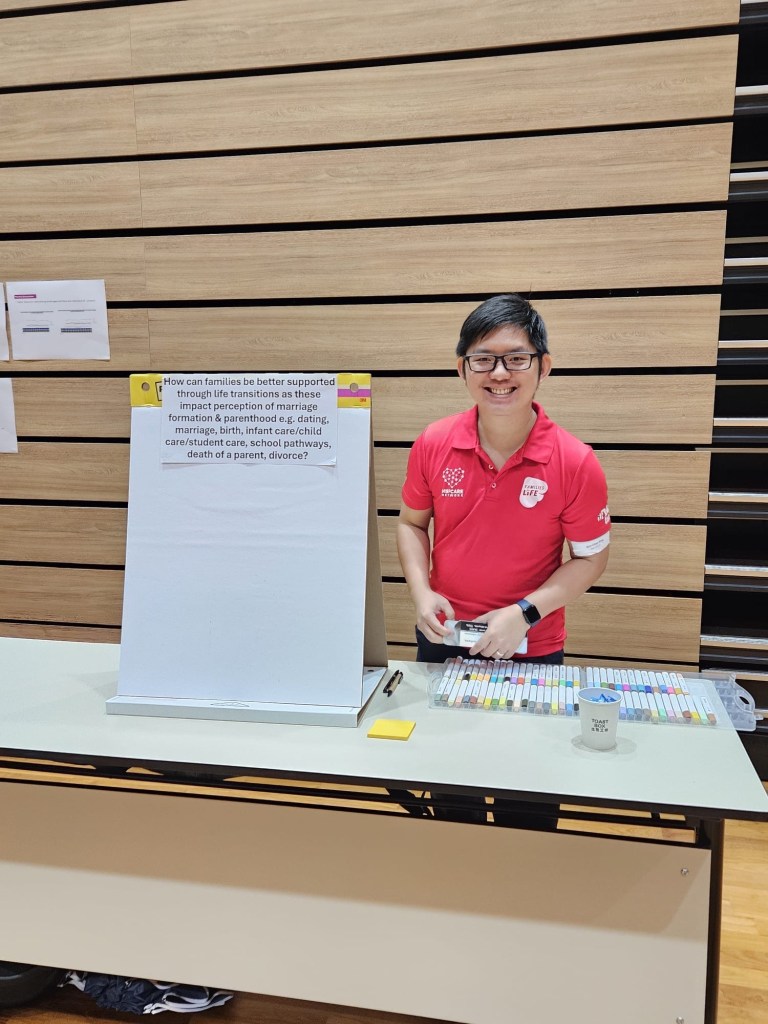
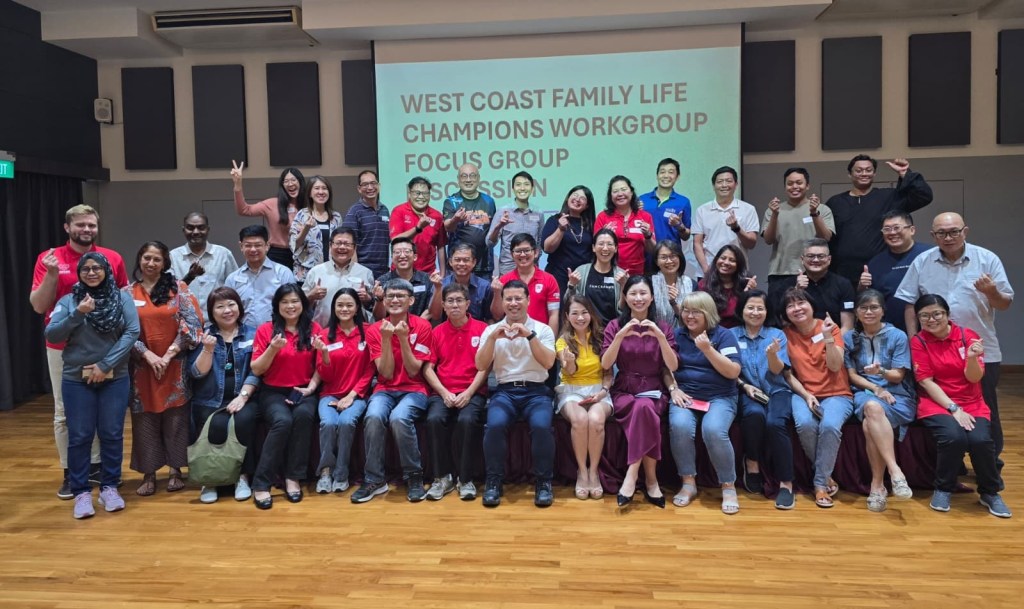
My current voluntary work with MSF’s Families for Life has given me a different but related perspective. Through workgroups involving stakeholders from across the community, I have had the opportunity to participate in conversations around difficult national issues such as declining fertility and how families in Singapore can be strengthened.
There is something different about hearing these issues discussed as problems before they become policies. A headline about Singapore’s low total fertility rate is easy to read and move past. A policy announcement can be consumed in much the same way. But a discussion requires you to sit with the issue for longer. You begin to ask why it is happening, what people are experiencing, what public policy can realistically influence, where individual choice begins and government intervention ends, and what trade-offs may be unavoidable.
When a problem is articulated in that way, government begins to feel less like a distant institution that simply produces policies and more like a system of people attempting, imperfectly, to respond to difficult questions.
That experience has made me wonder whether public engagement is sometimes framed too narrowly.
When people are unfamiliar with something, our instinct is often to educate them. We simplify the language, create explainers, publish infographics, organise seminars and produce bite-sized content. All of these efforts are useful, but understanding alone does not necessarily create a sense of connection. A person may know how a system works and still feel that it has little to do with them beyond the obligations it imposes.
Perhaps meaningful engagement begins when people are given some way to participate—not by turning every citizen into a policymaker, but by inviting them into the questions, tensions and choices that sit beneath the policy itself.
This is where I find myself returning to tax.
How does this translate to Tax Education?
Tax education often begins with the system as it exists. We explain what is taxable, what is deductible, how GST works, what obligations businesses have, and what reliefs or exemptions may apply. For people who need to navigate the system, this information is essential.
But perhaps public engagement could sometimes begin one step earlier. Instead of beginning with the tax rule, we might begin with the problem the tax system is trying to help address.
An ageing population, for example, raises questions about how the cost of healthcare and social support should be shared across generations. Singapore’s position as a global business hub requires us to think about how competitiveness can be balanced with the need for a sustainable revenue base. Scarce land brings housing, infrastructure, wealth and inequality into the same conversation. The growth of the digital economy raises increasingly difficult questions about where economic activity takes place and which jurisdiction should have the right to tax it.
Seen this way, these are no longer merely technical tax questions. They are questions about fairness, economics, competitiveness, demography, responsibility and the kind of society we want to build.
That distinction matters because it changes who gets to participate in the conversation.
A member of the public may have little interest in the mechanics of a tax provision, but they may care deeply about whether the healthcare system remains affordable, whether younger generations bear a disproportionate burden, whether businesses can continue to compete internationally, or whether public resources are distributed fairly. Taxation becomes relevant not because everyone suddenly becomes interested in tax law, but because tax is connected to questions they already care about. Perhaps this is one way of thinking differently about tax literacy.
The goal need not be to turn every citizen into a tax expert. Nor should public engagement be measured only by how well people understand tax rules. There may be value in helping people see taxation as part of a broader civic conversation about how a society raises resources, distributes burdens and funds collective priorities.
Once we frame the issue this way, the question changes. Instead of asking only how we can teach people more about tax, we might also ask how we can help people understand the choices that sit behind the tax system, and how they might be invited to think about those choices with us. For me, that is where education begins to turn into engagement.
Will we have meaningful tax engagements?
Tax may always remain something that most people would rather not think about. Perhaps the aim, then, is not to make everyone interested in tax for its own sake, but to help make visible the questions and choices that sit behind it.
If people can see how taxation connects to the issues they already care about — families, housing, healthcare, ageing, inequality, economic growth and the future of the country — perhaps tax begins to feel less like a distant obligation and more like part of a larger public conversation.
And perhaps that is where meaningful engagement begins: not simply by explaining the system better, but by giving people a reason to see themselves within the questions the system is trying to answer.
Maybe, just maybe, public engagement begins when people can see themselves in the question, rather than merely being told the answer.
Note. These are my personal reflections and do not represent the views or positions of any organisation I am affiliated with.


Leave a comment