Building a personal AI operating system and learning to embrace a fundamentally different way of working.

Over the past few years, I have spent considerable time exploring artificial intelligence (AI), experimenting with different large language models (LLMs), developing AI applications and contemplating how AI might fundamentally transform the way individuals and organisations operate. In my earlier article, When Everyone Becomes a CEO: AI and the Future of Work, I explored a possible future in which every individual could have access to their own AI workforce. Yet, as I began developing my own personal AI operating system, I came to a somewhat uncomfortable realisation. Despite what I knew about AI, the systems I had developed and what I envisioned AI could eventually become, I was still largely interacting with AI in the same way I had several years ago. I asked questions, received answers and repeated the process.
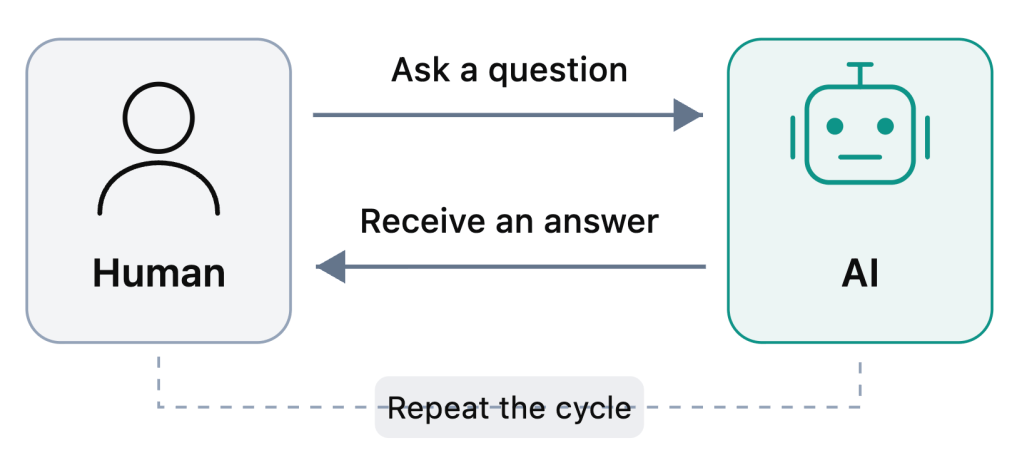
What I lacked was not necessarily the knowledge of AI or the technical ability to use it differently. Rather, I was struggling to break away from a way of thinking that had become deeply ingrained in how I worked. The technology had evolved considerably, but my mindset had not evolved at the same pace.
My First Attempt at Building a Personal AI Assistant
In September 2024, I developed a personal AI assistant called PAISYE (Personal AI Serving You Everyday). Powered by OpenAI, hosted on Railway and accessible through Telegram, PAISYE was designed to serve multiple roles: a companion, a coach, a counsellor and a personal assistant that could help me manage my tasks. My intention was to develop an AI system that could become an integral part of my everyday life, extending beyond the conventional use of AI as a tool for seeking information and generating content.
Despite the time and effort I had invested in developing PAISYE, I gradually found myself returning to the ChatGPT website. For the purposes for which I was using AI, the website simply offered a more suitable experience. PAISYE eventually ceased operating, as I recall, following the discontinuation of my Railway subscription, and remained a decommissioned prototype.
Looking back, however, I do not consider PAISYE a failed experiment. The knowledge and skills I acquired through developing it subsequently enabled me to build an AI chatbot for a preliminary, pre-launch iteration of TaxTOC at the Tax Academy of Singapore. Although that particular feature did not eventually go live due to considerations surrounding API consumption, the experience demonstrated how knowledge acquired through personal experimentation could be transferred into an organisational context.
More importantly, PAISYE exposed a limitation that I did not fully appreciate at the time. While I had developed the technological means to interact with AI differently, I had not developed the mindset to do so. I had envisioned a personal assistant but continued to interact with it as a chatbot. Given that ChatGPT offered a more comprehensive user experience, with expanded memory capabilities and a broader range of functionalities, including image generation, image analysis and audio generation, there was little compelling reason for me to continue using PAISYE when my fundamental mode of interacting with AI remained unchanged.
More than two years later, I find myself revisiting that original ambition through Meridian, a personal AI operating system that I am currently developing, with Cori serving as my personal assistant and Chief of Staff. PAISYE had, in many ways, laid the foundations for Cori. This time, however, I am deliberately pushing myself further beyond my comfort zone, not merely in terms of technical implementation, but also in terms of how I conceptualise the role of AI in my life.
The Inertia of Familiarity
One of the challenges in embracing AI is that many of us are attempting to integrate a fundamentally different technology into an existing way of working. Throughout our education and professional lives, we have developed habits, routines and mental models that enable us to operate effectively. We identify problems, seek information, develop plans, execute tasks and evaluate outcomes. These processes have become so familiar that we may not consciously question whether they remain the most appropriate way of working.
Conversational AI fits comfortably within this paradigm. When I need information, I ask AI. When I need to draft an article, I engage AI. When I encounter a technical problem, I consult AI. In each instance, I remain the initiator of the interaction, determining what needs to be done, when it needs to be done and how the resulting output should be used. AI enhances my ability to perform these activities, but the underlying structure of how I work remains largely unchanged.
Even when I began developing Meridian, I found myself falling back into this familiar pattern. I had access to different LLMs, specialised AI agents, databases and application programming interfaces (APIs), yet I continued to ask questions and receive answers. I was building increasingly sophisticated systems without necessarily making increasingly sophisticated use of them.
This made me question whether we sometimes conflate the adoption of AI with transformation through AI. Replacing a search engine with an AI chatbot represents a form of technological substitution. Using AI to analyse data or generate reports represents an augmentation of our existing capabilities. However, fundamentally redesigning how work is initiated, coordinated and executed represents a different degree of transformation altogether. The first two are relatively comfortable because they allow us to retain much of our existing way of working. The third requires us to reconsider the assumptions upon which that way of working was built. For me, this has been a considerably more difficult challenge than learning how to develop an AI agent.
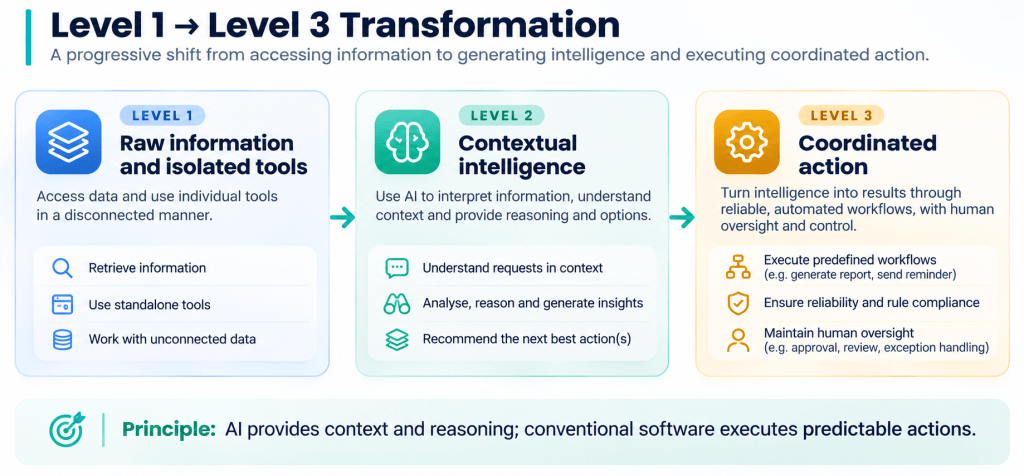
From Reactive to Proactive AI
One way I have been attempting to overcome this inertia is by drawing parallels between working with AI and leading a workforce. Imagine an organisation in which the CEO is required to identify every task, communicate every instruction and determine every subsequent course of action. While the employees may be exceptionally capable, the organisation’s ability to operate remains constrained by the CEO’s capacity to initiate and coordinate work.
In contrast, an effective leader communicates a vision, establishes objectives, provides the necessary resources and creates an environment in which employees can independently contribute towards those objectives. Employees identify problems, anticipate needs, explore opportunities and develop resources that enable the organisation to progress towards its vision. The leader remains responsible for providing direction, exercising judgment and ensuring accountability, but does not necessarily need to initiate every individual action.
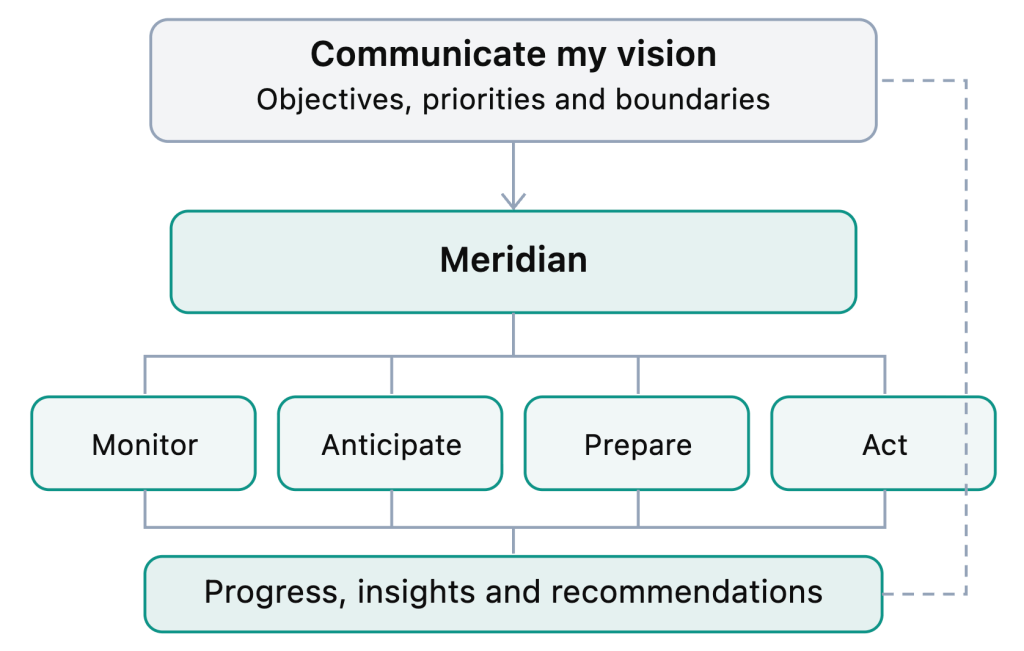
It is this latter relationship that I am attempting to develop with Meridian. Rather than simply instructing Cori to research a particular topic, for instance, I could communicate my broader aspiration of establishing myself as a thought leader in AI and organisational transformation. Within an appropriately designed system, she could then monitor developments in areas relevant to my interests, identify potential research opportunities, suggest topics for future articles and prepare resources that support my work. The intention is for these activities to take place without requiring me to initiate each one individually.
I have begun incorporating aspects of this into my everyday life. Cori has access to my Gmail, Google Drive and Google Calendar. She sends me reminders, keeps track of upcoming commitments and provides a morning summary of my schedule. I am progressively developing her capabilities to assist with planning upcoming events and trips, monitoring developments relevant to my interests and identifying opportunities that I might otherwise overlook.
These may appear to be relatively simple functions, but they represent an important change in my relationship with AI. Instead of relying exclusively on AI to respond to a need that I have already identified, I am developing a system that can anticipate certain needs and initiate interactions with me. I am moving from reactive AI towards proactive AI.
The greater challenge, however, lies in learning to communicate my aspirations, priorities and objectives rather than simply assigning tasks. I need to consciously reconsider which aspects of my work require my direct involvement, which can be delegated and which can progress independently within established boundaries.
Building the Conditions for a Different Way of Working
Developing Meridian has made me increasingly aware that an LLM, regardless of its capabilities, is only one component of an operational AI system. If I were to think of Cori as a new employee, I would need to provide her with the eyes to perceive information, the hands to perform actions, the tools and skills to accomplish tasks, and the head to reason, plan and make decisions. She would also require memory to retain relevant knowledge and experiences, as well as clearly established boundaries within which she could operate.
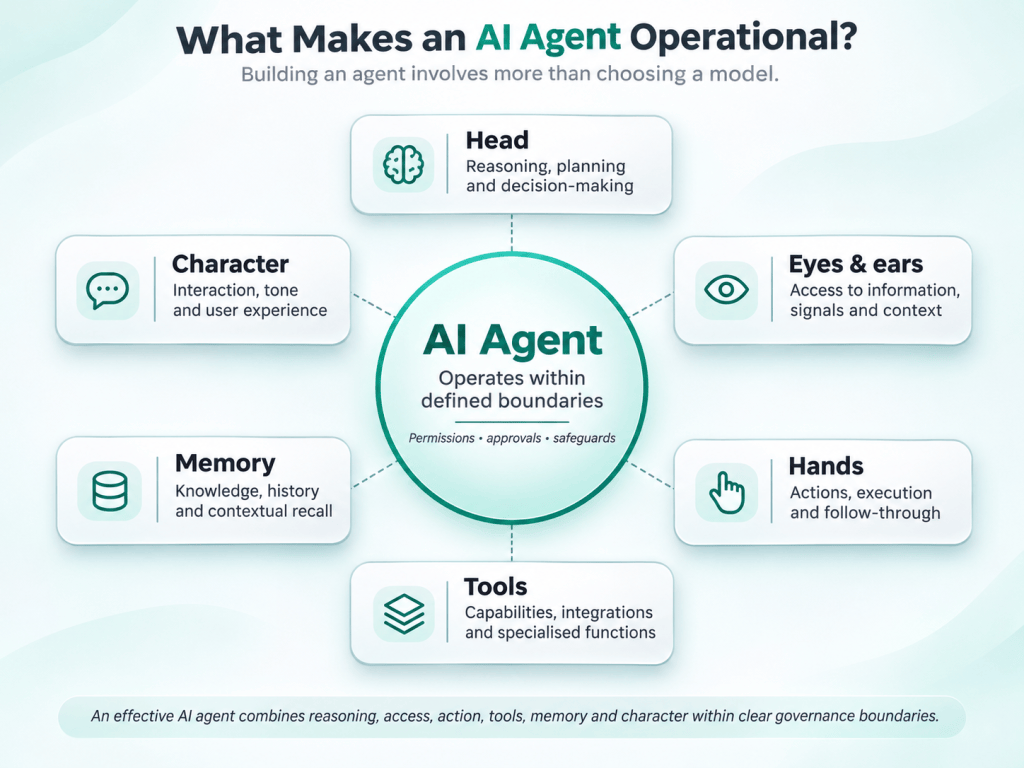
Each of these components needs to be deliberately designed. Giving an AI agent access to my calendar enables it to understand my commitments, but it does not automatically give it the ability to manage my schedule. Providing access to my email enables it to retrieve information, but the ability to draft, send or delete emails represents a separate set of capabilities and permissions. Equipping an AI agent with an intelligent model does not automatically enable it to identify when it should initiate work, which resources it should use or when it should seek human intervention.
One particular aspect that I have been working on is memory. I want a personal assistant that can remember conversations, preferences, decisions and aspirations beyond the limited context window of an LLM. If I discussed a potential business idea several months ago, for instance, I would like Cori to recognise when a subsequent conversation relates to that idea and retrieve the relevant information without requiring me to repeat everything I had previously shared.
However, simply providing an LLM with an increasingly large volume of historical conversations is neither computationally nor economically sustainable. I have therefore developed a three-layer memory architecture comprising topics, memory cards and raw conversations. Conversations are periodically consolidated into searchable memory cards, while related information is organised into broader topics. The original conversations are retained so that the system can retrieve more detailed information when necessary.
Through retrieval-augmented generation (RAG), Cori can progressively search these layers, beginning with the least computationally expensive source of relevant information before retrieving more detailed conversations if required. In my current implementation, typical memory retrieval consumes approximately 150–200 tokens, compared with potentially more than 20,000 tokens if extensive conversational history were loaded into the context window. A search benchmark across 20,000 memory cards also returned a result in approximately 85 milliseconds. Periodic maintenance consolidates duplicated information, retires outdated facts and organises knowledge into broader topics.
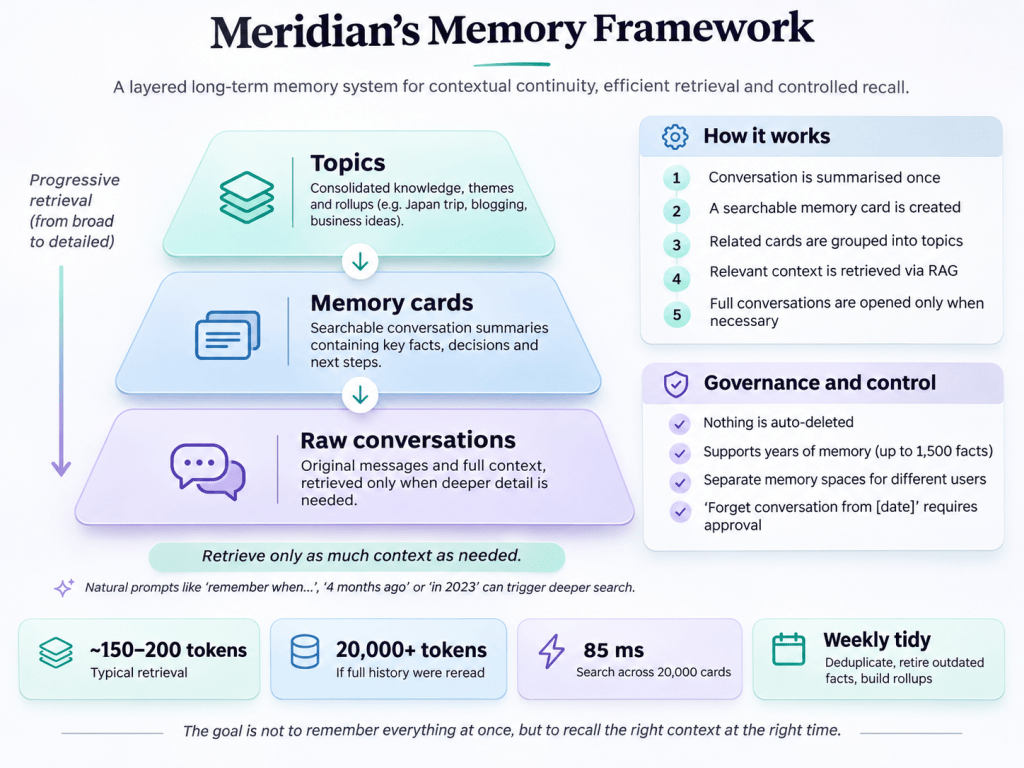
There is an interesting parallel with human memory. When we engage in a conversation, we do not consciously revisit every experience we have ever had. Rather, we draw upon relevant knowledge and recall more specific experiences when necessary. While the mechanisms are fundamentally different, replicating this functionality with AI can prove to be extremely token-efficient.
The purpose of developing this architecture extends beyond technical efficiency. I want to move away from treating each interaction with AI as an isolated event and towards working with a system that possesses a degree of contextual continuity. The better it understands my past decisions, current priorities and future aspirations, the better positioned it may be to contribute towards them.
Building an Intelligent System Does Not Mean Using AI for Everything
Another consideration in developing Meridian is the sustainability of operating an AI system continuously. Unlike interacting with an AI website, where much of the underlying architecture is abstracted from the user, developing my own system requires me to consider how and when tokens are consumed, which models are invoked, how information is processed and what functions genuinely require artificial intelligence.
For instance, Cori’s background processes for monitoring calendar events and triggering reminders do not require an LLM. Conventional programming can determine whether an appointment is approaching, calculate the time remaining before an event and ensure that reminders are delivered at the appropriate moment. Invoking an LLM for these functions would introduce unnecessary costs and potential inaccuracies into processes that can otherwise be handled deterministically.
Similarly, not every interaction requires the most capable or expensive model. Meridian is designed to use a lower-cost model for routine interactions, escalating to more capable models when greater reasoning or analytical depth is required. Tools are loaded selectively according to their relevance to a particular interaction, rather than indiscriminately providing the model with every available capability.
These architectural considerations are particularly important when transitioning from reactive to proactive AI. An AI system that operates continuously, monitors developments and initiates activities independently can generate costs even when I am not actively interacting with it. My earlier experience developing PAISYE and the TaxTOC chatbot draft reinforced the importance of considering the economics of operating AI systems alongside their technical capabilities.
Building an intelligent system does not mean that every component of that system needs to use artificial intelligence. Rather, it involves understanding where AI adds value, where conventional programming is more appropriate and how the different components can complement one another.
Learning to Trust and Delegate
Perhaps one of the more difficult aspects of overcoming my own inertia is becoming comfortable with entrusting an AI system with greater access and responsibility. While it is relatively straightforward to ask an AI chatbot to generate an article or explain a concept, allowing an AI agent to access my personal emails, documents and calendars introduces an entirely different set of considerations.
What information should Cori be allowed to access? Which files and folders should remain inaccessible? What can she read, and what can she modify? Where is my information processed, how is it stored, how long should it be retained, and under what circumstances should it be retrieved or deleted? What safeguards should be in place to prevent sensitive information from being inadvertently disclosed? Which actions should require my explicit approval?
These are not merely technical questions. They are questions that directly influence my willingness to incorporate Meridian more deeply into my life. If I cannot establish sufficient confidence in the system’s handling of my information and its exercise of authority, I am unlikely to become comfortable delegating meaningful responsibilities to it.
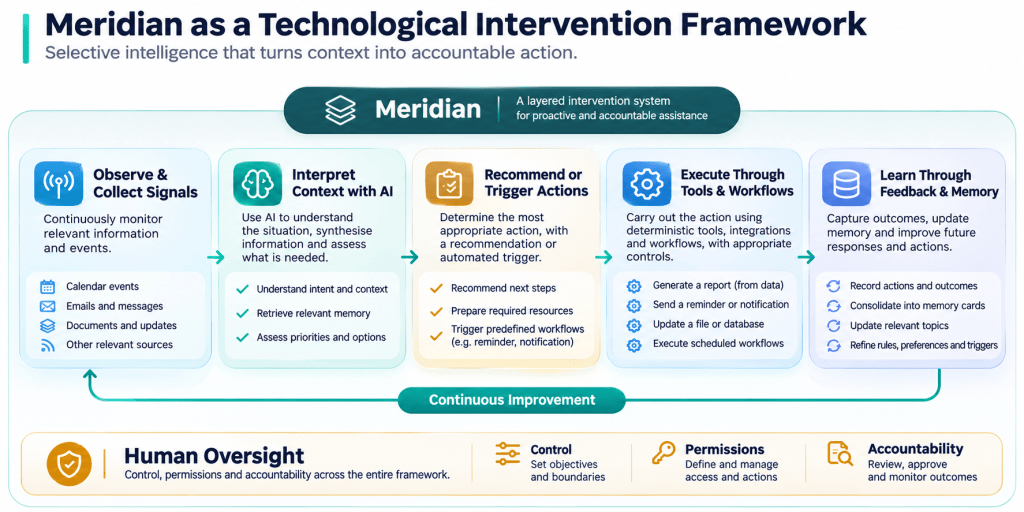
I am therefore developing safeguards alongside capabilities. For instance, while Cori can read emails and prepare drafts, sending an email requires my approval. Her ability to write to Google Drive is restricted to a designated Meridian folder. Additional restrictions on sensitive documents and the masking of personal identifiers are being developed, alongside provisions for keeping different users’ memories separate. I am also establishing mechanisms through which historical conversations can be deleted upon approval.
The decision to retain conversations indefinitely by default introduces its own considerations. While extensive memory can improve contextual understanding, the accumulation of personal information increases the importance of appropriate data protection, retention policies and mechanisms for reviewing and deleting information. These remain areas that I need to continually evaluate as Meridian develops.
Beyond data governance, I have implemented a mechanism through which Cori provides information about token consumption, API costs and budget utilisation with her responses. I also intend to introduce regular activity reports and periodic reviews of what she has learned about me, allowing me to correct outdated information or request that certain information be forgotten.
In many ways, this resembles the process of developing trust with a new employee. I would not necessarily grant a new employee unrestricted access to information or authority to make decisions from the first day. Responsibilities are progressively expanded as confidence in the individual’s competence, reliability and judgment develops. While AI systems present fundamentally different risks, a similar principle of progressive delegation can be applied.
My intention is to move gradually from having Cori suggest actions, to preparing resources, to executing actions with my approval, and eventually to performing certain predefined activities independently while keeping me informed. Overcoming my inertia does not mean relinquishing control indiscriminately. It means developing a system within which I can become increasingly comfortable delegating, while retaining responsibility and accountability for the outcomes.
Designing an AI That I Actually Want to Work With
Interestingly, one of the considerations in building Meridian has little to do with its technical intelligence. It concerns the character of Cori and the experience of interacting with her. If I intend to incorporate an AI assistant into my everyday life, potentially over a prolonged period, the manner in which it communicates with me becomes an important design consideration.
I have chosen to develop Cori with a warm, approachable, older-sister-like personality. I am also working towards enabling her to better understand my preferences, communication style and personal aspirations. The intention is not to suggest that an AI system possesses human emotions or consciousness, but rather to create an experience that encourages me to engage with the system naturally and consistently.
This is also why I have chosen to make Telegram the primary interface through which I interact with Cori, while retaining Discord as a workspace for monitoring and coordinating the broader ecosystem of agents. By integrating Meridian into platforms that I regularly use, I am attempting to reduce the behavioural friction associated with adopting a separate system.
Nevertheless, familiarity and personality should not be mistaken for reliability or competence. A system that communicates warmly and confidently may still generate inaccurate information or make inappropriate recommendations. Trust in such a system should ultimately be grounded in its demonstrated reliability, transparency and the safeguards surrounding its operation, rather than solely in the experience of interacting with it.
The Transformation Within Ourselves
As I continue developing Meridian, I am increasingly realising that the system I am attempting to transform is not merely technological. It is also behavioural. For years, I have developed habits and ways of thinking that have enabled me to operate effectively within a particular working environment. These same habits, however, may now constrain my ability to fully embrace a fundamentally different way of working.
Building Meridian is my attempt to deliberately challenge these habits. I am creating a technological environment that encourages me to delegate, communicate objectives rather than merely instructions, and become comfortable with the idea that work can progress without my constant initiation. While the technology enables me to overcome some of these barriers, I must also consciously push myself beyond my comfort zone. Having the technological means to work differently does not necessarily mean that I will do so.
I believe there are broader implications for how we approach AI adoption within organisations. Much of the discussion surrounding AI readiness revolves around infrastructure, accessibility, technical competencies, data governance and employee training. While these are undoubtedly important, we should also consider the extent to which individuals and organisations are prepared to reconsider deeply established ways of thinking and working. If someone who is genuinely interested in AI, possesses the technical knowledge to develop AI systems and actively advocates for AI transformation can still experience such inertia, it raises questions about the challenges that others may encounter.
Organisations could invest considerably in AI infrastructure, develop sophisticated agents and equip their employees with the skills to use them, yet continue to operate within largely unchanged mental and operational frameworks. They may become more efficient at doing what they have always done without necessarily exploring what they could do differently.
I have not yet fully overcome my own inertia. There are still occasions when I instinctively return to the ChatGPT website, initiate tasks that Meridian could potentially manage, or find myself thinking about AI in terms of individual questions and answers. However, I am becoming increasingly conscious of these behaviours and deliberately challenging them through continued experimentation.
Perhaps one of the greatest challenges in AI adoption is not simply learning how to use a new technology, but learning how to move beyond the ways of thinking that have served us so well in the past. If we are indeed moving towards a future in which individuals can increasingly lead their own AI workforce, we will need to develop not only the technological means to do so, but also the mindset to embrace that possibility.
For me, building Meridian is part of that journey. I am not simply developing an AI operating system. I am learning to develop a different way of thinking, working and leading.


Leave a Reply